
International Initiatives
Bonn Call-for-Action
The conference was co-sponsored by the World Health Organization (WHO), hosted by the Government of Germany and attended by 536 participants and observers from 77 countries and 16 organizations. An important outcome of the conference was the identification of responsibilities and a proposal for priorities for stakeholders regarding radiation protection in medicine for the next decade. This specific outcome is the Bonn Call-for-Action.
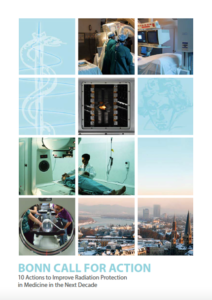
The aims of the Bonn Call for Action are to:
- Strengthen the radiation protection of patients and health workers overall.
- Attain the highest benefit with the least possible risk to all patients by the safe and appropriate use of ionizing radiation in medicine.
- Aid the full integration of radiation protection into health care systems.
- Help improve the benefit/risk-dialogue with patients and the public.
- Enhance the safety and quality of radiological procedures in medicine.
The Bonn Call-for-Action highlights ten main actions, and related sub-actions, that were identified as being essential for the strengthening of radiation protection in medicine over the next decade. The actions are not listed in order of importance.
The ten main actions:
- Justification
- Protection and Safety
- Manufacturer’s role
- Education and training
- Research
- Global information
- Incidents and accidents
- Culture
- Benefit Risks dialogue
- Global requirements
The Bonn Call For Action 5 years later
In December 2017, the IAEA, in partnership with the WHO and the Pan-American Health Organization, hosted the International Conference on Radiation Protection in Medicine: Achieving Change in Practice in Vienna, Austria. The goal of this conference was to provide an overview of the actions and developments since the 2012 Bonn conference.
The conference, with 530 participants from 100 countries, five days of presentations and round tables, acknowledged the work performed in numerous jurisdictions around the world to promote the Bonn Call-for-Action and outlined what more should be done to enhance awareness and implementation.
The International Society of Radiology Quality and Safety Alliance (ISRQSA)
The International Society of Radiology collaborates with the International Atomic Energy Agency (IAEA) and the World Health Organization (WHO) to focus on the implementation of the Bonn Call for Action and the International Radiation Basic Safety Standards (BSS). These standards have been first published by the IAEA in 1996, to establish basic requirements for protection against the risks associated with exposure to ionizing radiation and for the safety of radiation sources. They result from the collaboration between multiple international organizations and have been developed from widely accepted radiation protection and safety principles. They have been revised and updated in 2014 considering the most recent findings of the United Nations Scientific Committee on the Effects of Atomic Radiation (UNSCEAR) and the latest recommendations of the International Commission on Radiological Protection (ICRP).
The ISR Quality and Safety Alliance (ISRQSA) drives the ISR’s quality and safety agenda, and acts as a convener and facilitator for continental, regional and national radiation protection, quality and safety campaigns. These campaigns are led primarily by radiologists and supported by their regional societies of radiology. Most of them are multi-stakeholder organizations, with medical physicists and radiographers on board, as promoted by Canada Safe Imaging. These campaigns include Image Wisely and Image Gently in the USA, EuroSafe Imaging, Canada Safe Imaging, AfroSafe Rad, LatinSafe, Japan Safe, Arab Safe, AsiaSafe.
ISRQSA and WHO have worked on a 3-year work plan for 2019-2021 to promote WHO’s initiatives. Besides facilitating the implementation of the International Radiation BSS and the Bonn Call for Action, the plan also addresses focal areas such as justification of medical imaging, multidisciplinary/team approach in the use of medical radiation, radiation risk communication, radiation safety culture in healthcare and use of medical imaging in individual health assessment of asymptomatic persons.
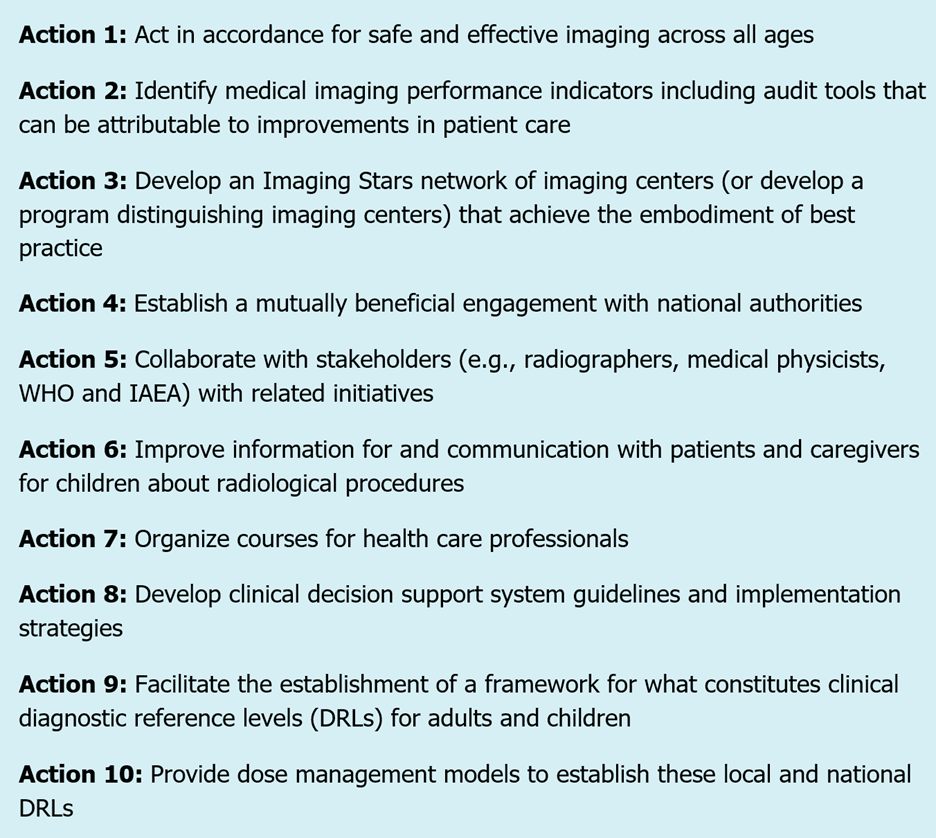
ISRQSA Call for Action
The following ISRQSA Call for Action is proposed to serve as a set of internationally relevant recommendations and guidelines for medical radiation safety, management, and informed use. In fulfilling its mission “…to facilitate the global endeavours of the ISR’s member organizations to improve patient care and population health through medical imaging”, the ISR and its Quality and Safety Alliance will function as both a primary actor as as a facilitator through this Call for Action.
The continental, regional, national initiatives
