
With engaging content presented by a variety of expert speakers, Through the Expert Lens: Mastering ILD Imaging was a resounding success.
A capacity audience ranging from trainees to full-practice radiologists took part in the accredited, 1.5-day workshop in Toronto in early October.
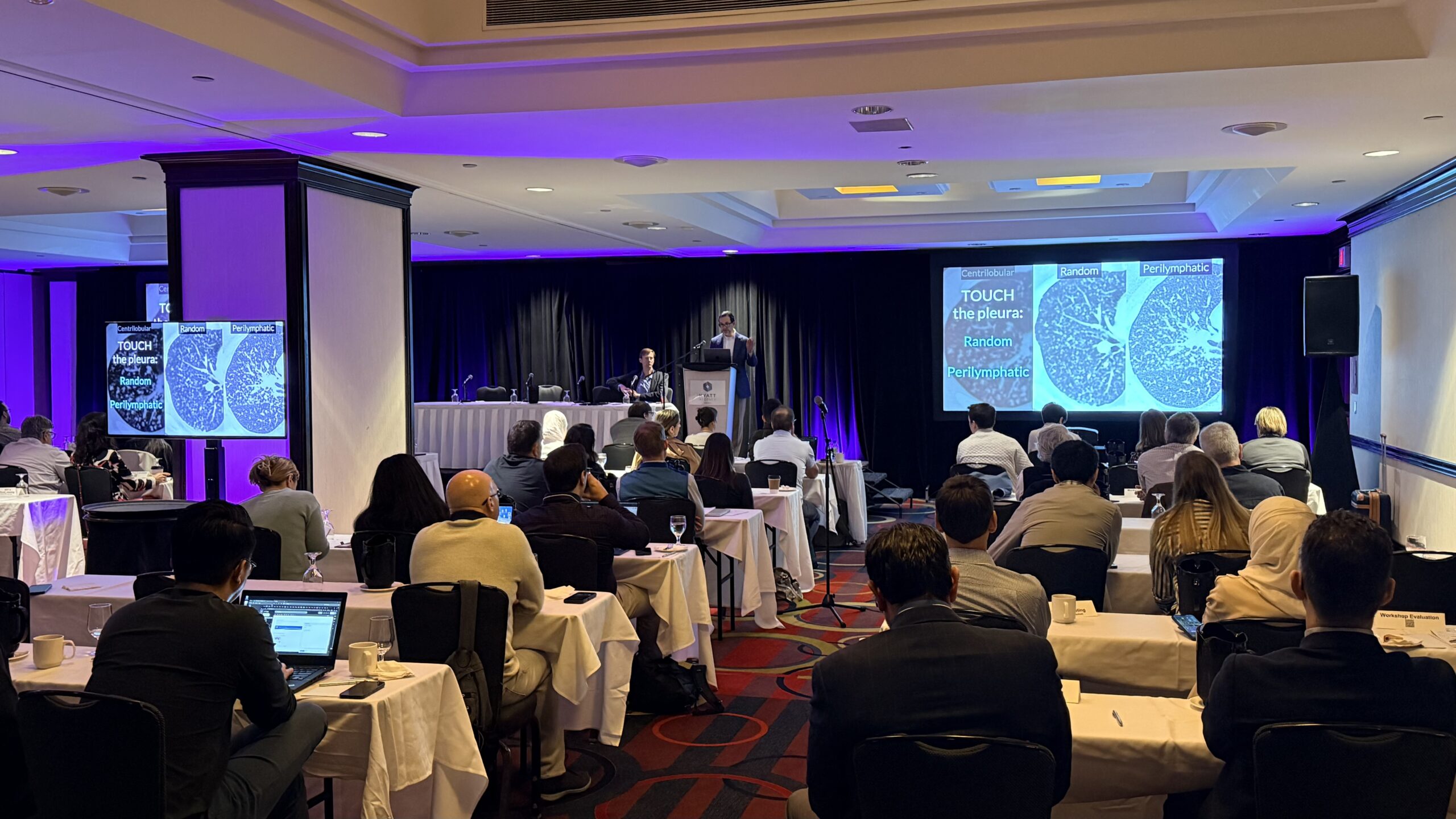
The Hyatt Regency hosted the workshop, a collaborative effort between the Canadian Society of Thoracic Radiology (CSTR) and the Society of Thoracic Radiology (STR).
“Inter-society collaboration fulfills an important mission. It brings together experts with different geographic representation and allows for a robust exchange of ideas,” said Co-Chair and workshop speaker Dr. Brett Elicker. “Learners benefited from hearing these different perspectives and witnessing the interactions of experts in the field in formats such as the mock multidisciplinary discussion.”
The event was a “read with the experts” workshop that mixed didactic lectures and case-based sessions. Dr. Cameron Hague co-chaired the workshop and is the CSTR President.
“We also held a ‘mock multidisciplinary discussion (MDD)’ meeting with the assistance of Dr. Shane Shapera (respirology) and Dr. Michael Cabanero (pathology) to allow attendees to see how ILD-MDDs are run and how we manage difficult cases,” explained Dr. Hague. “I think attendees gained a broad overview of the more common interstitial lung diseases and gained specific insight into some of the pitfalls that are present when interpreting HRTC in this space.”
From the scientific content to the logistics of hosting the workshop, Dr. Hague says he and Dr. Elicker have heard positive feedback all around.
“I have heard from staff both with and without subspecialty training in chest imaging as well as thoracic training fellows,” he said. “They comment that the content was a great mixture of common interstitial entities as well as more esoteric diagnoses. Participants really enjoyed the mock MDD and the case-based sessions, with numerous mentions of how well these varied components of the workshop complimented each other and helped solidify retention and understanding of disease entities. Content and speakers were excellent and administrative support ensured everything ran smoothly for both speaking faculty and our audience.”
After the workshop, attendees were also asked which practice changes they’d make, to which they offered encouraging responses like “add confidence to my diagnosis and more confident in reading ILD cases” and “I will likely refer fewer patients to lung biopsy.”
Congratulations to the co-chairs and everyone involved in making the workshop a success!