
The Canadian Association of Radiologists Journal (CARJ) has selected an educational paper by Dr. Smily Sharma and colleagues (University of Toronto) as its latest CARJ Invited Paper. Titled Demystifying Imaging Patterns of Substance Abuse-Related Lung Injury (SARLI), the review is based on an educational exhibit presented at CAR 2026.
The CARJ Invited Paper initiative highlights an educational exhibit presented at the CAR Annual Scientific Meeting, providing national visibility to the work of trainees and early-career radiologists. Selected for its relevance to clinical practice, Dr. Sharma’s paper provides a case-based guide to recognizing and differentiating pulmonary toxicities caused by recreational substance use.
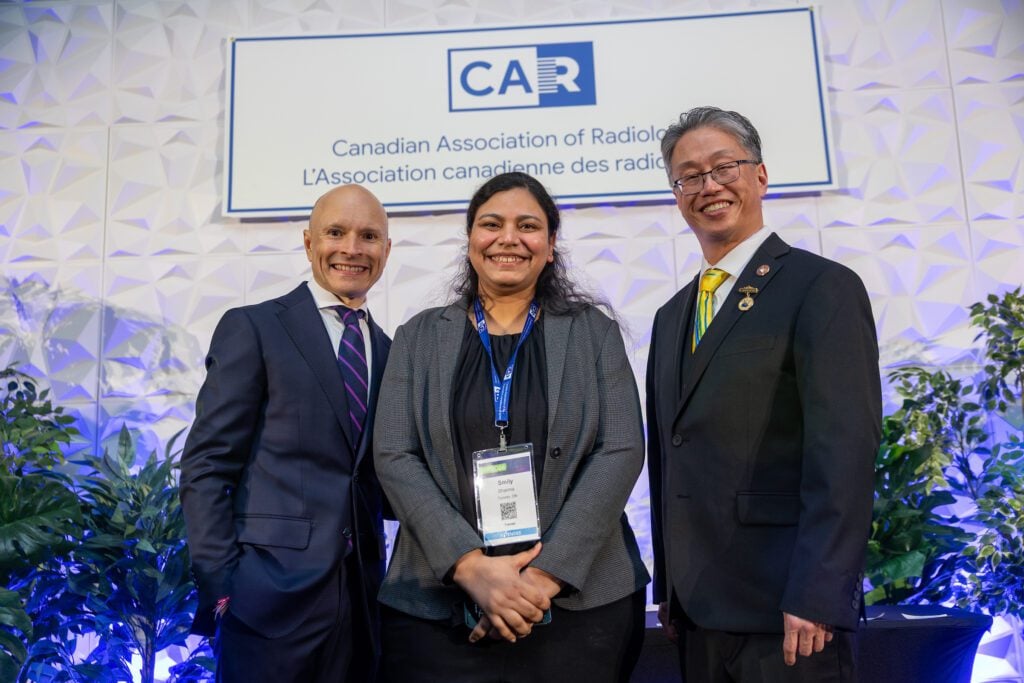
“In chest imaging, we see the effects of substance use all the time, from crack lung to infections to organizing pneumonia, yet it’s rarely discussed as a unified theme, despite its public health importance. My interest started at our teaching rounds, where we discussed a patient with talcosis, and grew when my supervisor showed me imaging of excipient lung disease, an entity that was new to me then,” she said. “Soon after, I began encountering crack lung, both in my day-to-day reporting and at our multidisciplinary rounds. I carried out a detailed literature review and presented it, using our own patients’ imaging, at our monthly combined rounds with radiologists, respirologists, and pathologists, and later at CAR 2026. The deeper I looked, the clearer it became how relevant this topic is, given rising rates of substance use in Canada and worldwide, and how much radiologists can contribute to recognizing these patients and improving their care.”
Dr. Sharma’s review describes the mechanisms and CT patterns of substance abuse-related lung injury (SARLI), whose injuries often mimic infection or pulmonary edema.
“Crack lung has acute respiratory distress syndrome (ARDS) like imaging within 48 hours of cocaine abuse; cannabis smoking is linked to upper-lobe emphysema and bullae; and vaping-associated lung injury most often shows an organizing pneumonia pattern. Injecting crushed oral tablets can cause excipient lung disease, which can appear as diffuse centrilobular micronodules, high-attenuation fibrotic opacities, or lower-lobe emphysema and may lead to pulmonary hypertension and sudden death. Recognizing these patterns in the right clinical and temporal context helps radiologists suggest the diagnosis and guide timely care.”
Seeing a project grow from an idea into a published paper felt incredibly rewarding, she said.
“Research takes persistence, and I couldn’t have done this without my supervisor, Dr. Micheal McInnis, my co-authors, Dr. Demetris Patsios and Dr. Dayana Davoudi, and the entire cardiothoracic radiology division at JDMI. I am especially glad the work is reaching a wider audience, because the topic matters in everyday practice and has real public health impact.”
Congratulations to Dr. Sharma and all co-authors on this achievement.