
For years, the Canadian Association of Radiologists has consistently delivered a clear message to Ottawa: diagnostic imaging is the primary gateway to the Canadian healthcare system, and that gateway is buckling under unsustainable strain.
Recently, this advocacy achieved a major milestone. The House of Commons Standing Committee on Health (HESA) formally invited the CAR to testify as part of its dedicated study on Canada’s diagnostic imaging capacity.
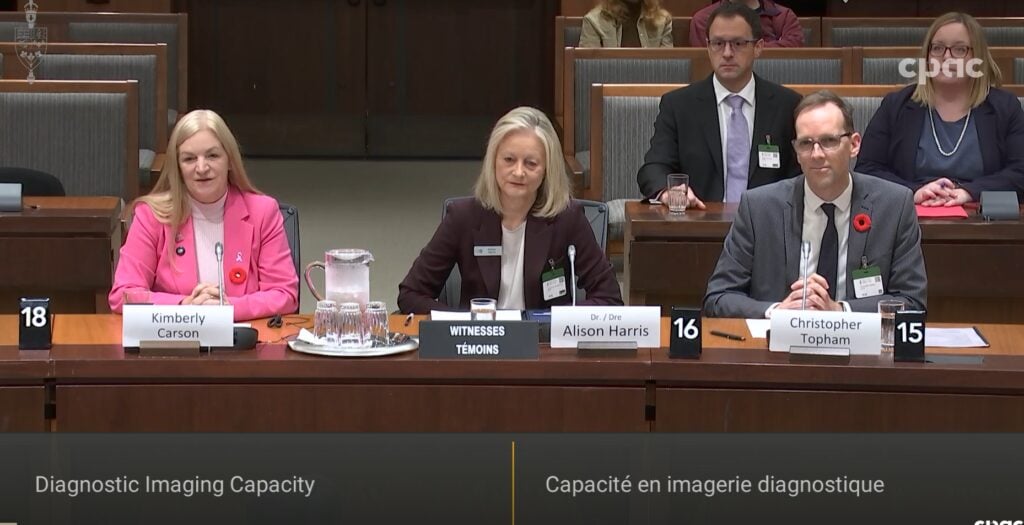
The initiation of this study represents a critical juncture in federal health policy. A parliamentary committee undertaking a comprehensive study focused on diagnostic imaging capacity is unprecedented. It serves as the culmination of years of strategic advocacy, continuous parliamentary engagement, pre-budget submissions, and the unified voices of our members demanding that medical imaging be recognized as the primary bottleneck defining Canadian healthcare access. The Committee’s decision to prioritize this issue demonstrates a growing recognition in Ottawa that surgical and specialist wait times cannot be meaningfully reduced without first resolving the backlog in radiology.
CAR President Dr. Alison Harris appeared before the Committee to deliver a resolute, policy-driven message on behalf of our members and the patients we serve. Dr. Harris presented a stark assessment of the current landscape – highlighting the physical and economic toll of delayed diagnoses – while pivoting to the actionable, federal solutions the CAR has long championed.
During her testimony, Dr. Harris anchored the CAR’s case on four critical pillars for federal investment:
- Modernizing Infrastructure: Advocating for a dedicated, long-term federal transfer to the provinces to replace aging MRI and CT fleets and expand net-new capacity with high-throughput technology.
- Bolstering Health Human Resources: Emphasizing that modern equipment requires highly trained radiologists and medical radiation technologists, and urging federal support to accelerate credentialing, training, and retention strategies.
- Scaling Clinical Decision Support (CDS): Urging the implementation of national, evidence-based CDS systems to ensure patients receive the right imaging test at the right time, thereby optimizing existing capacity and reducing low-value scans.
- Advancing HAIVN – the Health AI Validation Network: Positioning Canadian radiology at the forefront of safe, regulated artificial intelligence adoption to streamline workflows and assist radiologists in managing overwhelming caseloads.
Dr. Harris’s testimony underscored that investing in radiology is not only a clinical necessity but an economic imperative. By framing the imaging backlog as a barrier to returning Canadians to the workforce, the CAR highlighted that failing to invest in diagnostic capacity costs the nation billions in lost productivity.
This invitation to testify reflects the credibility and influence the CAR has established on Parliament Hill. We are no longer solely raising the alarm; we are actively providing policymakers with the blueprint for a sustainable solution.
The CAR will continue to monitor the Committee’s study and engage with parliamentarians as they draft their final report and recommendations to the federal government. We will keep members informed on the outcomes of this study and its impact on the upcoming federal budget cycle.